The aluminium and steel industries operate within highly demanding supply chains where product quality must be maintained from the manufacturing facility to the customer’s production line. Whether transporting steel coils, aluminium sheets, pipes, profiles, fabricated components, or finished assemblies, manufacturers face challenges such as impact during handling, vibration in transit, compression from stacking, and shifting loads caused by braking or cornering. Even minor damage to edges, corners, or surfaces can lead to rejected shipments, increased scrap, production delays, customer complaints, and higher logistics costs.
Studies conducted by the International Safe Transit Association (ISTA), along with established industrial packaging standards such as ASTM and ISO, identify impact, vibration, compression, and inadequate load securing as the leading causes of transport-related packaging failures. For metal products, these risks are particularly significant because dimensional accuracy, edge integrity, and surface finish directly influence downstream processes such as slitting, laser cutting, stamping, roll forming, welding, machining, and automated assembly. A dented steel coil or scratched aluminium sheet often cannot be restored to its original quality, making preventive packaging considerably more economical than replacement or rework.
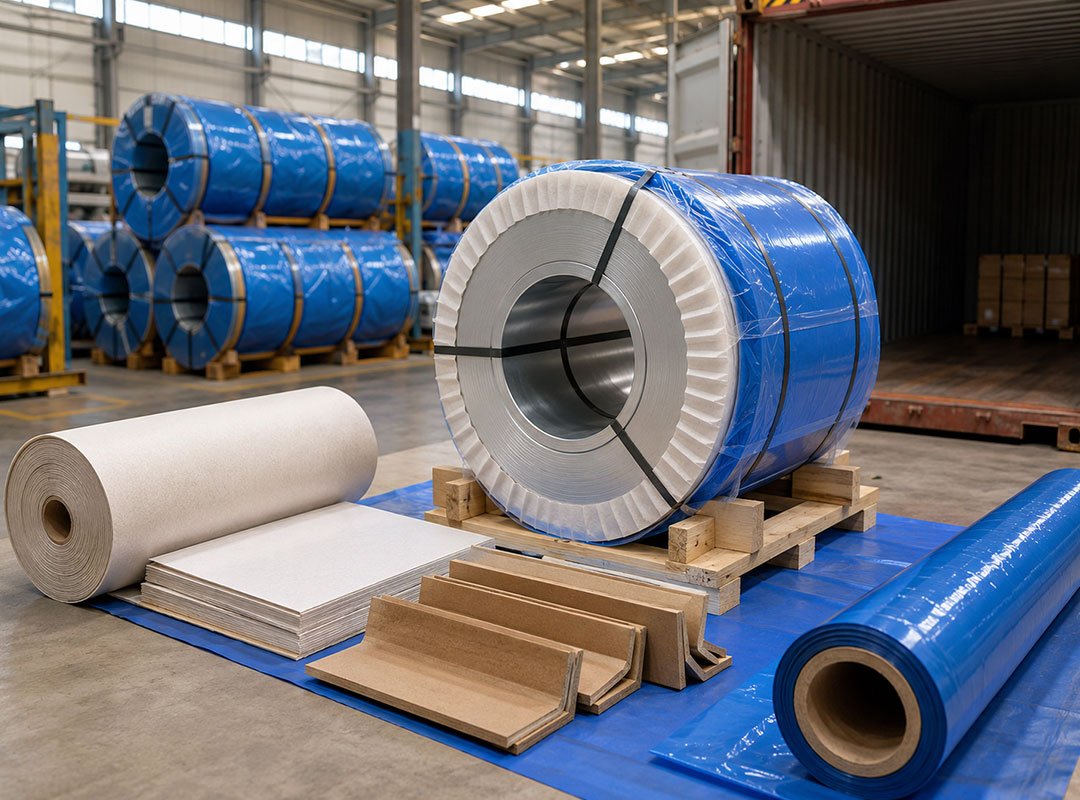
Among the most widely adopted industrial packaging solutions for protecting metal products are Angle Boards and OD (Outer Diameter) Protectors. These engineered packaging components are designed to reinforce packaged loads, distribute mechanical stress, protect vulnerable edges and coil diameters, and improve overall load stability throughout storage and transportation. Today, they are extensively used by steel mills, aluminium manufacturers, metal service centres, automotive suppliers, construction material manufacturers, appliance producers, and exporters to reduce transit damage while improving packaging efficiency and product reliability.
This article explains how Angle Boards and OD Protectors reduce transit damage in aluminium and steel packaging and why they have become indispensable components of modern industrial packaging systems.
1. Edge Protection Prevents the Most Common Form of Transit Damage
The edges and corners of aluminium and steel products are the first areas exposed to mechanical impact during loading, unloading, stacking, and warehouse movement, making them the most vulnerable to dents, deformation, chipping, and coating damage. Unlike flat surfaces, edges concentrate impact forces over a very small area, increasing the risk of permanent defects that affect dimensional accuracy and downstream manufacturing operations. This is particularly critical for products supplied to automotive, aerospace, electrical, white goods, and precision engineering industries, where strict dimensional tolerances and surface quality standards must be maintained. Engineered Paper Angle Boards create a rigid protective barrier around exposed edges by absorbing external impacts and distributing the force across a wider surface area, significantly reducing stress concentration on the product itself. By preventing edge damage throughout the logistics cycle, manufacturers can minimize material rejection, reduce rework, improve customer satisfaction, and maintain the structural integrity of high-value aluminium and steel products.
2. Uniform Load Distribution Improves Compression Resistance During Stacking
Steel coils, aluminium sheets, pipes, and fabricated metal products are routinely stacked on pallets, warehouse racks, shipping containers, and transport vehicles to maximize storage utilization and freight efficiency. Without adequate edge reinforcement, the weight of upper loads creates concentrated pressure, known as point loading, which can crush exposed edges, distort sheet profiles, and permanently deform packaged products. Angle Boards distribute compressive forces uniformly across the entire edge, converting localized pressure into evenly distributed vertical loads that improve the compression resistance of the complete package. This engineered load transfer enables palletized shipments to withstand higher stacking pressures while maintaining product geometry during prolonged storage and international transportation. By reducing stress concentrations and improving stacking performance, Angle Boards help prevent compression-related damage, making them an essential component of industrial packaging for heavy steel coils, aluminium bundles, extrusions, and fabricated metal assemblies.
3. OD Protectors Preserve Coil Geometry and Structural Integrity
Steel and aluminium coils represent some of the highest-value products in the metals industry, making protection of their outer diameter essential throughout the supply chain. During transportation, lifting, and storage, the exposed circumference of a coil is susceptible to dents, flattening, scratches, and impact damage that can compromise subsequent manufacturing operations such as decoiling, slitting, roll forming, stamping, and automated feeding. Even localized deformation along the coil edge can interrupt production, increase scrap generation, and reduce material yield. OD Protectors are specifically engineered to create a protective buffer around the coil’s outer diameter, absorbing localized impacts and preventing direct contact between the coil surface and external objects during handling or stacking. By preserving the coil’s circular geometry and maintaining dimensional consistency, these protectors help manufacturers reduce processing issues while protecting coated, galvanized, colour-coated, anodized, polished, and stainless steel coils where surface quality directly determines product value.
4. Better Strap Performance Creates Stronger and More Stable Loads
Strapping is one of the most important methods of securing aluminium and steel products during storage and transportation, but excessive strap tension can create localized pressure that damages exposed edges and corners when applied directly to the product. Paper Angle Boards act as protective interfaces between the strap and the packaged load, allowing manufacturers to apply higher strap tension without causing indentation, coating damage, or edge deformation. By increasing the contact area between the strapping material and the package, they distribute tension more evenly, reducing stress concentrations while significantly improving load stability. Stronger unitization minimizes the risk of load shifting caused by vibration, sudden braking, acceleration, or cornering during transportation, helping maintain package integrity throughout the distribution cycle. Better strap performance also enhances warehouse safety by reducing the likelihood of unstable palletized loads during storage, forklift handling, and unloading operations.
5. Protection Against Vibration, Dynamic Forces, and Repeated Handling
Transportation subjects aluminium and steel products to far more than static loads. During road, rail, and sea transit, cargo experiences continuous vibration along with dynamic forces generated by acceleration, braking, cornering, and uneven road conditions. These forces can loosen strapping, shift palletized loads, and create metal-to-metal contact, resulting in scratches, edge wear, and structural deformation. Multiple handling cycles across warehouses, ports, and distribution centres further increase the risk of impacts from forklifts, cranes, and material handling equipment. Paper Angle Boards enhance package rigidity by reinforcing the load and reducing relative movement between bundled products, while OD Protectors shield the exposed circumference of coils against accidental impacts during lifting and stacking. Together, they improve load stability throughout the supply chain, reducing the likelihood of transit-related damage before the material reaches the customer’s production facility.
6. Protecting Surface Finish in High-Value Metal Products
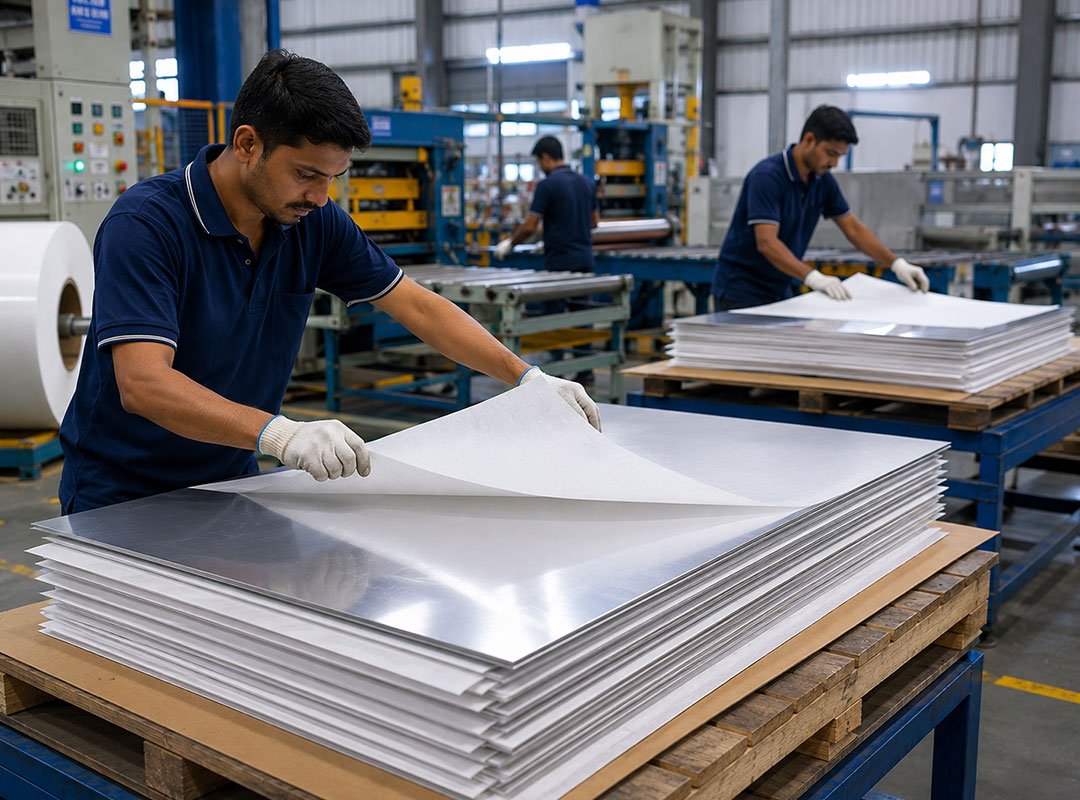
For many metal manufacturers, preserving the surface finish of a product is just as critical as maintaining its structural integrity. Products such as anodized aluminium sheets, colour-coated steel coils, galvanized sheets, decorative stainless steel, and pre-painted metal panels are manufactured to meet stringent aesthetic and functional requirements. Even minor scratches, abrasions, or coating damage can result in product rejection or additional processing costs. Angle Boards and OD Protectors prevent direct contact between packaged products and external surfaces during stacking, handling, and transportation, significantly reducing the risk of friction-induced damage. When integrated with protective packaging materials such as VCI films, PE sheets, foam separators, or stretch wraps, they create a comprehensive packaging system that safeguards both the appearance and performance of premium metal products throughout domestic and export shipments.
7. Engineered Kraft Paper Angle Boards Deliver Exceptional Strength
Despite being manufactured from paper, modern Angle Boards are engineered to withstand substantial mechanical loads. They are produced by laminating multiple plies of high-strength recycled or virgin kraft paper using industrial-grade adhesives, creating a dense structure with excellent compression strength and high edge crush resistance. This engineered construction enables the boards to distribute both vertical and lateral loads efficiently while retaining their shape under demanding stacking conditions. Their high strength-to-weight ratio allows manufacturers to reinforce heavy steel coils, aluminium bundles, pipes, fabricated sections, and palletized shipments without adding significant package weight. Compared to alternative protective materials, engineered kraft Paper Angle Boards provide an ideal balance of durability, handling efficiency, cost-effectiveness, and environmental responsibility, making them one of the most widely adopted edge protection solutions in industrial packaging.
8. Supporting Export Packaging and Sustainable Supply Chains
Export shipments expose aluminium and steel products to extended transit durations, multiple handling stages, varying climatic conditions, and high container stacking loads. Protective packaging must therefore maintain its structural integrity throughout the logistics cycle to ensure products reach international customers without damage. Angle Boards and OD Protectors reinforce packaged loads, improve compression resistance, and help maintain load stability under demanding transportation conditions, reducing the likelihood of transit-related claims and costly product replacements. In addition to enhancing shipment reliability, kraft paper-based Angle Boards contribute to more sustainable packaging practices. Manufactured from recyclable paper fibres, they help reduce dependence on plastic-based protective materials and support circular economy initiatives adopted by manufacturers worldwide. As global industries place increasing emphasis on environmentally responsible packaging, recyclable protective components have become an important consideration alongside performance, durability, and cost efficiency.
Transit damage remains one of the most persistent challenges in the aluminium and steel industry, where even minor edge deformation, coil damage, or surface defects can affect product quality, disrupt downstream manufacturing processes, and increase operational costs. Investing in engineered protective packaging is therefore not simply about preventing physical damage but about improving supply chain efficiency, reducing waste, minimizing customer complaints, and protecting the value of every shipment.
Paper Angle Boards and OD Protectors play a crucial role in achieving these objectives by reinforcing packaged loads, distributing compression forces, protecting vulnerable edges and coil diameters, improving strap performance, and maintaining product stability throughout transportation and storage. Their ability to reduce transit damage while supporting efficient handling and sustainable packaging practices has made them indispensable across industries including automotive, construction, engineering, metal service centres, appliances, and infrastructure.
With growing expectations for product quality and increasingly complex global supply chains, reliable industrial packaging has become a strategic investment rather than an operational expense. Chetak Industries manufactures high-quality Paper Angle Boards, OD Protectors, and other industrial packaging solutions designed to meet the demanding requirements of aluminium and steel manufacturers. By combining precision manufacturing, durable materials, and application-specific designs, Chetak Industries helps businesses strengthen their packaging systems, reduce logistics-related losses, and ensure that products arrive at their destination in the same condition in which they left the production facility.